

When the English settlers initially meandered their way down the Eastern Seaboard to the area of the country now known as Virginia, they discovered the type of tobacco grown and smoked by the natives. This strain of tobacco was the Nicotiana rustica and the English found it rather unpleasant. In fact, William Strachey—one of the first historians of the Virginia settlement—said that the native tobacco was, “poore and weake, and of a byting taste.” In 1611, John Rolfe decided to experiment with the cultivation of a higher-quality leaf in Jamestown. Obtaining from a shipmaster some Nicotiana tabacum seeds from Trinidad and Venezuela, Rolfe went into the tobacco business. On July 20, 1613, Captain Robert Adams of the Elizabeth delivered samples of Rolfe’s tobacco to England, where it was pronounced to be “excellent in quality.” By 1618, forty-thousand pounds of Virginia tobacco were being exported to the British Isles. Rolfe’s success inspired others to begin the cultivation of tobacco and it soon became the primary crop throughout the colony.
In 1866—the year that Jessie James committed his first bank robbery in Liberty, Missouri—Cornelius Bailey began to cultivate tobacco on a plot of land in Keysville, Virginia. The business became successful and its ownership was transferred from generation to generation before ending up in the hands of Mac Bailey and his son, Steven. In 1994, the duo decided to enter the manufacturing side of the tobacco business, establishing S&M Brands (Steven and Mac) to produce a line of cigarettes. The company’s value-priced Bailey’s brand was soon accepted by the target consumer and S&M eventually enhanced its product assortment with pipe tobacco, electronic vapor products, and small cigars. After twenty years of manufacturing and distribution experience, Steven Anthony Bailey—Cornelius’ great great grandson—launched a new division of the company to produce “the most exquisite cigars on the market.” He named the operation Cornelius & Anthony.
Last year, Cornelius & Anthony introduced four new premium cigar blends—the Cornelius, the Daddy Mac, the Venganza, and the Meridian (though the latter was technically a re-launch/re-blend of a previous blend from 2015). The last three are produced at Erik Espinosa’s La Zona operation in Nicaragua, while the Cornelius is manufactured at the esteemed El Titan de Bronze factory in Miami, under the watchful eyes of Sandra Cobas—where the splendid La Palina Goldie cigars are also rolled. The company states:
The Cornelius blend has a layered complexity with notes of both sweetness and spice…a refined blend that culminates with a buttery smooth finish.
Click images below for full resolution


Cornelius Corona Gorda Breakdown
- Wrapper: Ecuadorian Habano
- Binder: Ecuadorian Habano
- Filler: Nicaragua | Dominican Republic
- Factory: El Titan de Bronze (USA)
- Production: Regular Production
- Vitola: 5½″ × 46 Corona Gorda
- Price: $12.00
The Cornelius & Anthony Cornelius was the first new blend the company released in 2016. This line of cigars is offered in three sizes—a Corona Gorda (5½” x 46, $12.00 MSPR), a Robusto (5” x 50, $13.50 MSRP), and a Toro (6” x 50, $15.00). Manufactured in the United States (hence the premium price), the vitolas are shipped in twenty-count cabinet boxes with a sliding lid. Covering the lid is a black and white engraving of a mustachioed man wearing a jacket and tie with a bowler hat—who is identified as Cornelius by a plaque residing beneath his four-in-hand-knotted tie. The rear of the box is stamped the name of the torcedor that rolled the cigars at the El Titan de Bronze factory in Miami.
The Cornelius is composed with an Ecuadorian Habano wrapper surrounding an Ecuadorian Habano binder. Premium long-leaf tobacco from Nicaragua is utilized for the filler formulation.
Appearance

The Cornelius and Anthony Cornelius Corona Gorda is a beautiful parejo-shaped cigar, with overall dimensions coming just under the sizing standards for a vitola traditionally receiving the classification—five and a half inches in length with a ring gauge of forty-six (traditionally being five and five-eighths inches long). Its Ecuadorian Habano wrapper is extremely smooth—very tight seams, almost invisible veins, zero tooth, and a perfectly applied triple cap. On the “shades of brown” spectrum, the Cornelius’ color falls between Desert Sand and Cocoa Brown. A light amount of oiliness produces a pleasant, tactile sensation when rolled between the fingers.
The cigar is equipped with a main band and a sub-band. The main band is lightly embossed and printed in the colors of black, gold, gray, and white. Resting in the center of the main band is the company’s “CA” logo with “CORNELIUS & ANTHONY” encased in two ribbons hovering above the logo, and “EST 1866” printed beneath in a diminutive typeface. The sub-band is printed in the colors of black and gold and identifies the cigar as a Cornelius. Expertly packed from the foot to the cap, the wrapper aroma is a subtle mix of cedar, leather, and natural tobacco, while the open foot smells of barnyard, earth, and dried fruits.
After the cap of the corona gorda is opened with a double guillotine cut—to ensure the maximum amount of taste from the wrapper, binder, and filler—the initial cold draw is fairly open and appropriate for a cigar of this size. Flavors of coffee, chocolate, citrus, and finely-aged tobacco immediately touch the palate.
Smoking Experience
After toasting and lighting the cigar with a soft double-flame lighter, the first few draws produces bold notes of cedar, leather, and natural tobacco. These initial flavors are quickly enhanced with touches of assorted nuts and damp earth. This combination quickly culminates in a smooth flavor profile that attractively coats the entire tongue and the roof of the mouth, while producing a lingering finish. The draw of the Cornelius is quite open, generating a prodigious amount of smoke output. Additional aromas and flavors of dried apricots, drip-brewed coffee, and milk chocolate add to the complexity of the cigar, while cedar and white pepper are dominant on the smooth retrohale.
As the Cornelius enters its second third, both the body and strength of the cigar remain in the medium range. The notes present in the first third continue to dominate the smoking experience, while the milk chocolate flavor begins to shift toward dark chocolate. Additionally, the initial note of drip-brewed coffee transitions to a stronger cup prepared in a French press. Attenuated flavors and aromas of almonds, earth, hay, and molasses flirt in and out of the mix, adding to the complexity of the cigar.
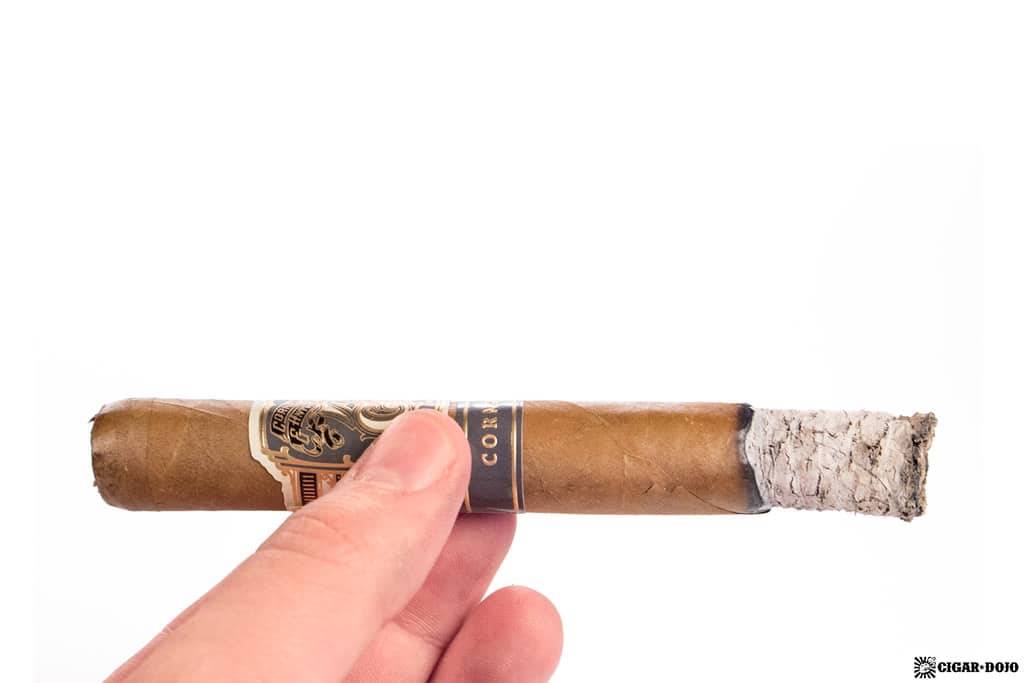
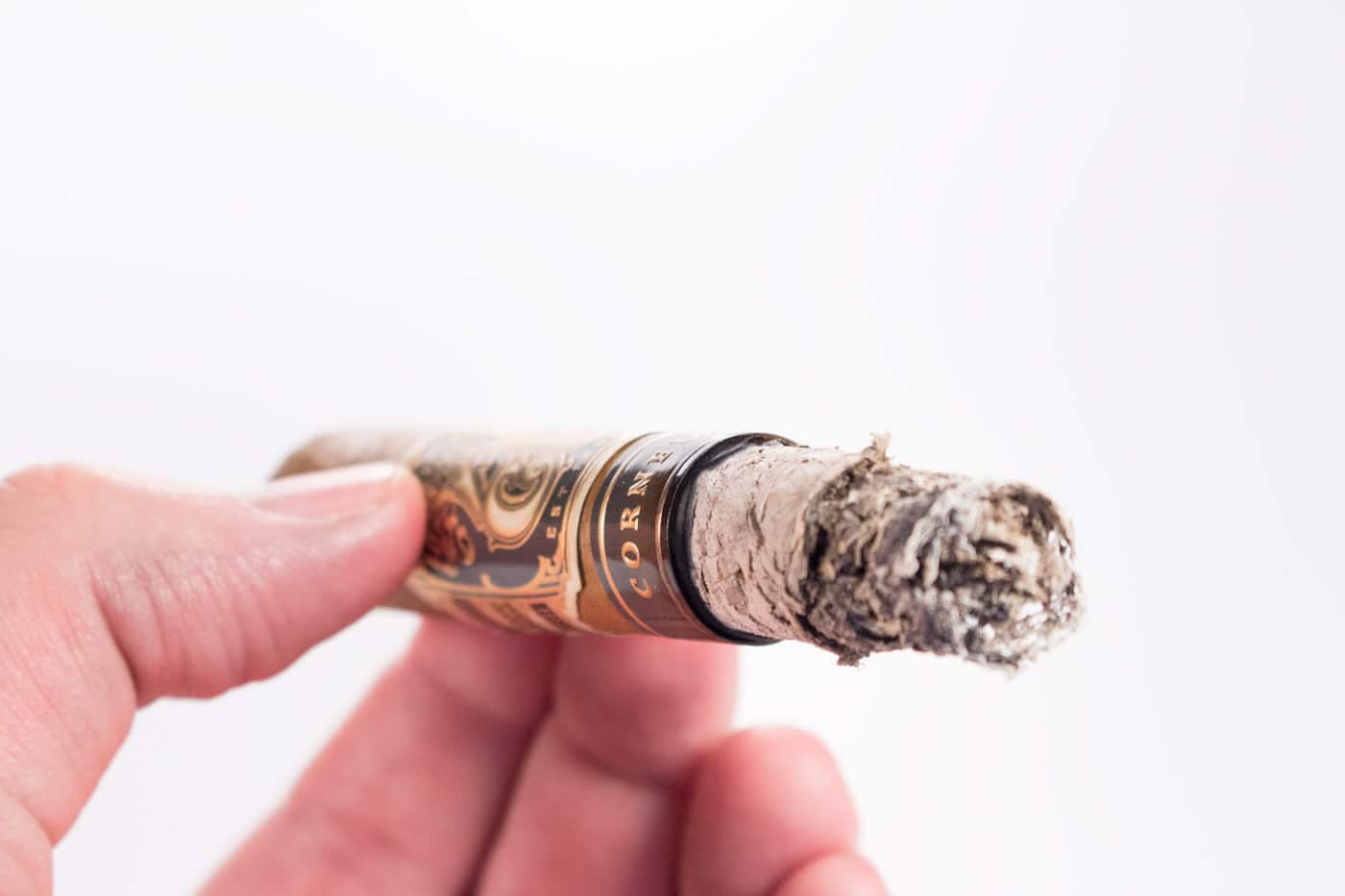
Room aroma is delicate but rich—aged tobacco burning in the smoking room with wafts of sweetness from oven-baked s’mores resting in the kitchen. The burn line wavers a bit, holding one and one-half inches of silver and white ash, highlighted with streaks of charcoal between the stacks. On the retrohale, the white pepper present in the first third is replaced by a mixture of red and black pepper, with trace amounts of tropical fruits.
As it burns down toward the nub, the cigar mirrors the aromas and flavors experienced in the second third. A few additional notes appear in spurts—dried hay, espresso bean, and oatmeal—but they quickly dissipate. The draw remains open, requiring only single puffs to produce bountiful amounts of ceiling-clinging smoke. Overall, the Cornelius & Anthony Cornelius Corona Gorda provides the cigar enthusiast with an enjoyable smoking experience—flavorful, polished, and sophisticated.

Would I Smoke This Cigar Again?
The answer to that question is, “On occasion.” The Cornelius Corona Gorda is a beautiful cigar with excellent construction and smooth flavors, but its price point puts the cigar in competition with super premium offerings, which provide much higher levels of complexity. While I intend to keep a few on hand, the Cornelius and Anthony Venganza is a better value.
- Smoke Time: 1 hour, 30 minutes
- Pairing Recommendation: double espresso, Chimay beer, Manhattan cocktail, scotch and soda
- Purchase Recommendation: 5-pack

Short Link:
- Lovely Appearance
- Great Construction
- Smooth Flavors
- Price Point
- Average Complexity