

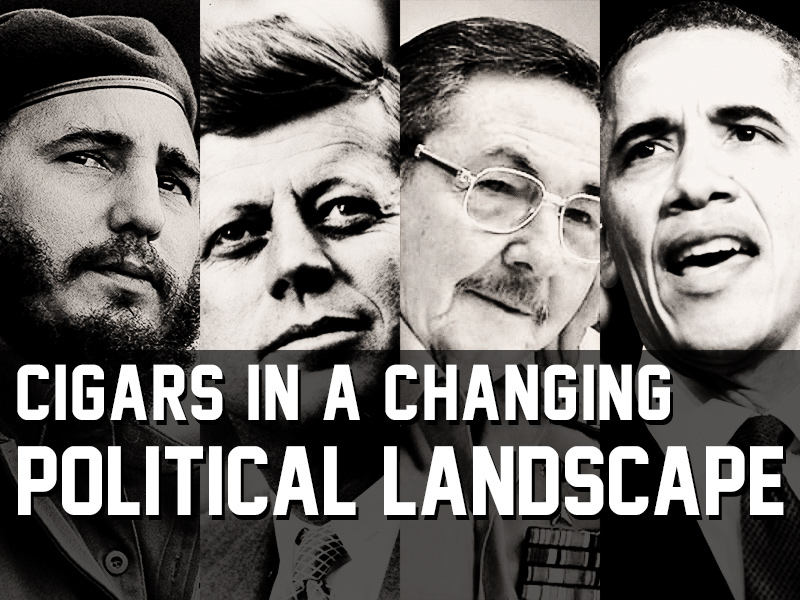
A fifty-year-era of absolute prohibition on Cuban cigars went up in smoke Wednesday as President Obama announced an agreement to normalize relations with Cuba. But reactions are mixed within the cigar community about whether the development is a step in the right direction.
“While smokers may benefit from relaxing these rules, there’s no doubt that the Cuban government also greatly benefits from the ability of American citizens to send more money over there,” said Matthias Clock, a New York-based marketing consultant in the cigar industry. “It could easily send the wrong message. Many cigar manufacturers who grow Nicaraguan, Honduran, and Dominican tobacco were chased out of the country, and they’ve put in a lot of hard work to rebuild their trade.”
The United States implemented sanctions on Cuba after Fidel Castro’s communist revolutionaries overthrew the government in 1959. Sanctions gradually increased until President John F. Kennedy signed off on a total embargo in 1962—though not before he had secured 1,200 Cuban cigars for himself.
Normalization of relations between the US and Cuba is a preliminary step to ending the embargo. Lifting it altogether requires Congressional approval, but the President’s deal set that process in motion, securing the release of imprisoned American aid worker Alan Gross, setting up diplomatic relations between the two countries, and permitting limited travel and spending on Cuban goods.
Under the new agreement, visitors to the Caribbean state can bring up to $100 worth of cigars back into the United States—though reselling them is still prohibited. That’s not enough money to buy a whole box of cigars in Cuba, but it may allow the purchase of a small handful.
What would lifting the embargo mean for the cigar industry? “It’s really tough to say,” answered Michael Herklots, Vice President of Nat Sherman Cigars. “There are some logistical issues, like trademarks and ownership, and how that translates to distribution. Clearly there would be a significant increase in interest in the hobby of cigars.”
Supporters of the deal argue that trade liberalization could bring economic freedom to Cuba and undermine the nation’s political totalitarianism. Milton Friedman famously argued that “economic freedom is an indispensable means toward the achievement of political freedom.” Trade breaks down barriers to private property ownership, strengthens independent civil society by creating intermediary institutions, and allows capitalism to gain a foothold. Exposure to Microsoft and McDonald’s could do more to topple Castro than the embargo.
On the other hand, Cuba remains a communist totalitarian state, despite meager economic reforms under Fidel’s brother Raul. Thousands of Cuban refugees watched their property and tobacco fields destroyed as they fled the regime’s red purge. Many resettled in Florida or other Central American states to transplant their tobacco trade. Cozying up to the communists appears to legitimize the expropriation of these refugees’ businesses and livelihoods.
Scott de la Peña, the owner of Hermosa cigars, says his immediate family narrowly escaped Cuba with their lives. He believes the normalization policy marks “a sad day in American diplomacy.”
“They left all their worldly possessions and family members behind,” de la Peña said. “It is unconscionable to us that this administration would receive no assurance of open elections …or even a public apology to Cuban-Americans, and yet still award diplomatic legitimacy to this evil regime.”
Politics aside, cigar enthusiasts acknowledge that many non-Cuban cigars can compete with Cuba’s best quality stogies.
“The non-Cuban market has developed very quickly in terms of quality because of the economic forces that are at work,” Clock said. “Cuban cigars at the time of the revolution were much better than the competition, just because the infrastructure was better and tradition was stronger. Today, there are non-Cuban cigars that compete with the very best Cuban cigars out there. Ultimately it’s a matter of preference about different flavor profiles.”
— Josh Craddock is a New York City brand ambassador for CigarDojo, the largest and fastest-growing digital community of cigar lovers.
Short Link: